

Blog · 22 April 2026 · 11 min read
How many grafts do I need for receding temples, the crown or a high forehead?
Anyone who only looks for the highest number of grafts is gambling with their donor area – we show you how the right strategy can give you a result that impresses today and still looks natural in ten years’ time.
Graft planning: how much hair is needed for a perfect result?
- Individual guide values: correcting receding temples usually needs 800–1,500 grafts, while a high forehead or the crown often requires capacities of 1,800 to more than 3,000 grafts to achieve natural fullness.
- Redistribution, not multiplication: because a hair transplant only redistributes hair, protecting the donor area is essential; reputable clinics extract no more than 35% of the reserves to prevent thinning at the back of the head.
- Strategic planning in stages: instead of “more is better”, what matters is forward-looking planning that takes progressive hair loss into account and preserves grafts as a precious resource for future densification.

“A graft is not just a figure on an invoice but a unique piece of biology. Our art lies in achieving the greatest possible aesthetic effect with the smallest possible number – because the reserves at the back of your head are the life insurance for your hairline of tomorrow.”
How many grafts do I need?
Anyone who googles “How many grafts do I need?” doesn’t want philosophy. They want a number. And that is exactly where the problem begins: the “right” number of grafts is not a fixed quantity but the result of the area, target density, hair quality, the hair you still have – and above all, what your donor area can provide in the long term.
Sound planning therefore always delivers two things at once: a realistic range for the desired zone, and an explanation of why, in your case, you are more likely to be at the lower or upper end of that range. That is exactly what you get in this article.

Short answer: typical graft ranges per zone
So that you have some immediate guidance, here are the values many plans start with – before the details (area, density, hair parameters) refine the final number:
- Receding temples (corners only / light front): typically approx. 800–1,500 grafts
- Receding temples + hairline (front frame): typically approx. 1,500–2,500 grafts
- High forehead (hairline moved forward / wider front area): typically approx. 1,800–3,000 grafts
- Crown (whorl / vertex): typically approx. 800–2,000+ grafts (depending on size and thinning)
Important: these ranges are not promises but starting points. As soon as the area is measured properly and a sensible target density is set, the number follows in a way you can understand – and often differs from what your gut feeling would expect.
What does “graft” actually mean – and why does it matter?
A graft is an extracted follicular unit. Depending on your genetics, a graft contains 1, 2, 3 or sometimes more hairs. This means that 2,000 grafts are not automatically 2,000 hairs but often considerably more. For the visual effect, however, it is not only the number of hairs that counts but also how these hairs sit in the recipient area.
Especially in sensitive zones such as the hairline and receding temples, the work is not done “as densely as possible” but aesthetically: finer at the front, stronger behind – with transitions that will not later look like a transplanted edge. In the crown, on the other hand, the direction of the whorl plays a major role. There you cannot simply put in a “wall of hair”; the whorl has to be built up so that it falls naturally.
This leads to an important point: the same number of grafts can look completely different on two people. Someone with thick, slightly wavy hair and little contrast between scalp and hair colour often needs fewer grafts for the same visual effect than someone with very straight, fine hair and a pale scalp.
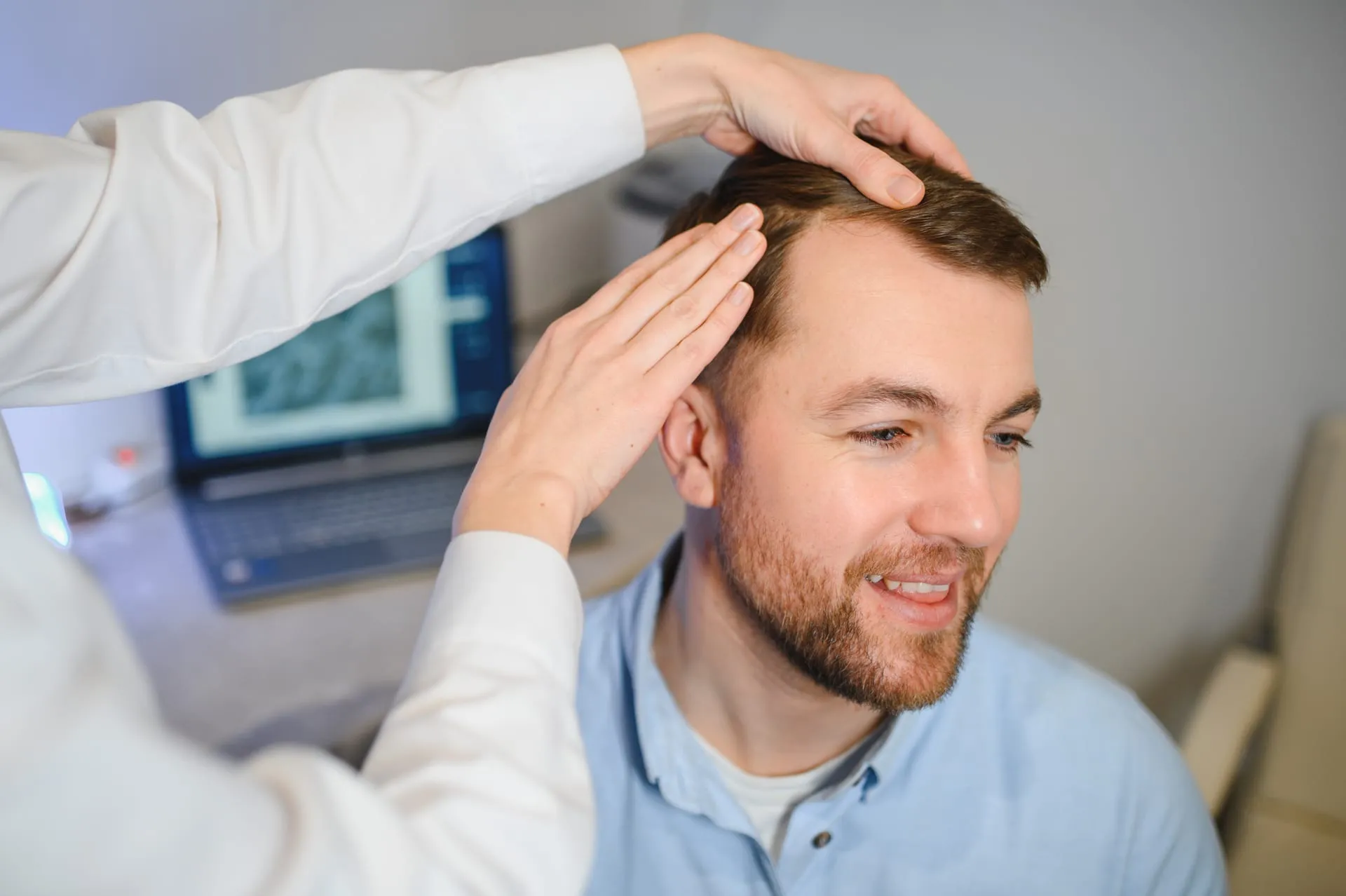
The most important truth: a transplant does not create new hair
A hair transplant is always a redistribution. That sounds trivial but is the core of any honest planning: whatever you move to the front or the top is taken from the donor area.
That is exactly why the question “How many grafts do I need?” is actually incomplete. The second, decisive question is: how many grafts can I afford to use without running into a dead end later?
From the Hair Doctors notes (and this is exactly how it is explained in reputable consultations): in the so-called fringe of hair at the back of the head, roughly 80 follicular units grow per square centimetre; in total, an average person has a reservoir of around 16,000 grafts in this area. But: only some of them can be extracted safely at all. About 35% is often given as a rough guide – because otherwise overly aggressive extraction becomes visible (“over-harvested”), the donor area thins out and the treated spots at the back of the head stand out.
This logic produces the practical figure you often hear: in the long term, many people have roughly 5,000 to 6,000 suitable grafts that can sensibly be transplanted over the years – not in a single step, but strategically.

Why “more is better” is almost always the wrong strategy
If you come across claims online such as “We’ll just do 4,000 grafts and then everything is sorted”, it sounds tempting at first. The catch: in most cases hair loss is progressive. This means that even if only your receding temples bother you today, the hair loss can spread further back or up.
If you plan very aggressively in the first session, this can create two problems later:
- The donor area is put under unnecessary strain. And if a follow-up treatment would make sense later, the reserves are limited.
- The aesthetics tip over. A very low hairline on a young patient can look unnatural in five to ten years if further areas behind it thin out.
Sound planning therefore thinks in stages: first create a natural frame (front/hairline), then – if necessary – densify later or add further zones. This is not a “tactic” to sell several sessions. It is the only strategy that remains stable in the long term.
How the number of grafts is calculated correctly (rather than estimated)
Once you have understood the calculation, you will very quickly recognise whether someone is giving you a plausible number or just marketing.
The basic formula is:
Grafts = area (cm²) × target density (grafts/cm²)

1) Area: how big is the zone really?
Many people overestimate the area because in the mirror they only see “bald” and don’t think in square centimetres. A receding temple can measure 8 cm² – or 25 cm². The crown can be a small, coin-sized patch – or an extensive area.
2) Target density: what is realistic – and what makes sense aesthetically?
The natural density at the back of the head is often higher than what should be transplanted or is even sensibly possible. A good result does not require “maximum density” everywhere. In the crown in particular, a moderate density often looks more natural, because the whorl always shows a little scalp.
Even more important: at the front, what counts is the impression of fullness created by direction, angle and distribution. A carefully designed hairline with the right transitions can look better with fewer grafts than an over-dense line that later looks like a strip of felt.
3) Hair parameters: why not all hair is the same
Three factors often shift the number of grafts needed considerably:
- Hair calibre: thicker hair gives more volume per graft.
- Waves/curls: more “body” and shadow effect.
- Contrast: dark hair on a pale scalp often needs more density than low contrast.
These factors are the reason why two patients with the same area get completely different graft plans.
Receding temples: how many grafts make sense?
Receding temples are the classic case, because they change the face immediately. Many people “just want their old hairline back”. This is exactly where it is decided whether a plan will look good in the long term.
What drives the number for receding temples
Receding temples are rarely just about two triangles. They are about the overall frame: hairline, transitions, temporal points, sometimes also the first front zone behind. As soon as the hairline is redesigned, the requirement rises.
A typical range looks like this:
- Just filling in small corners: typically 800–1,500 grafts
- Corners + balancing the front zone/hairline: typically 1,500–2,500 grafts
Why this range is so wide: the hairline is not a straight line. It is a design. And design means micro-irregularities, finer single hairs at the front, and more two- and three-hair grafts behind for density.
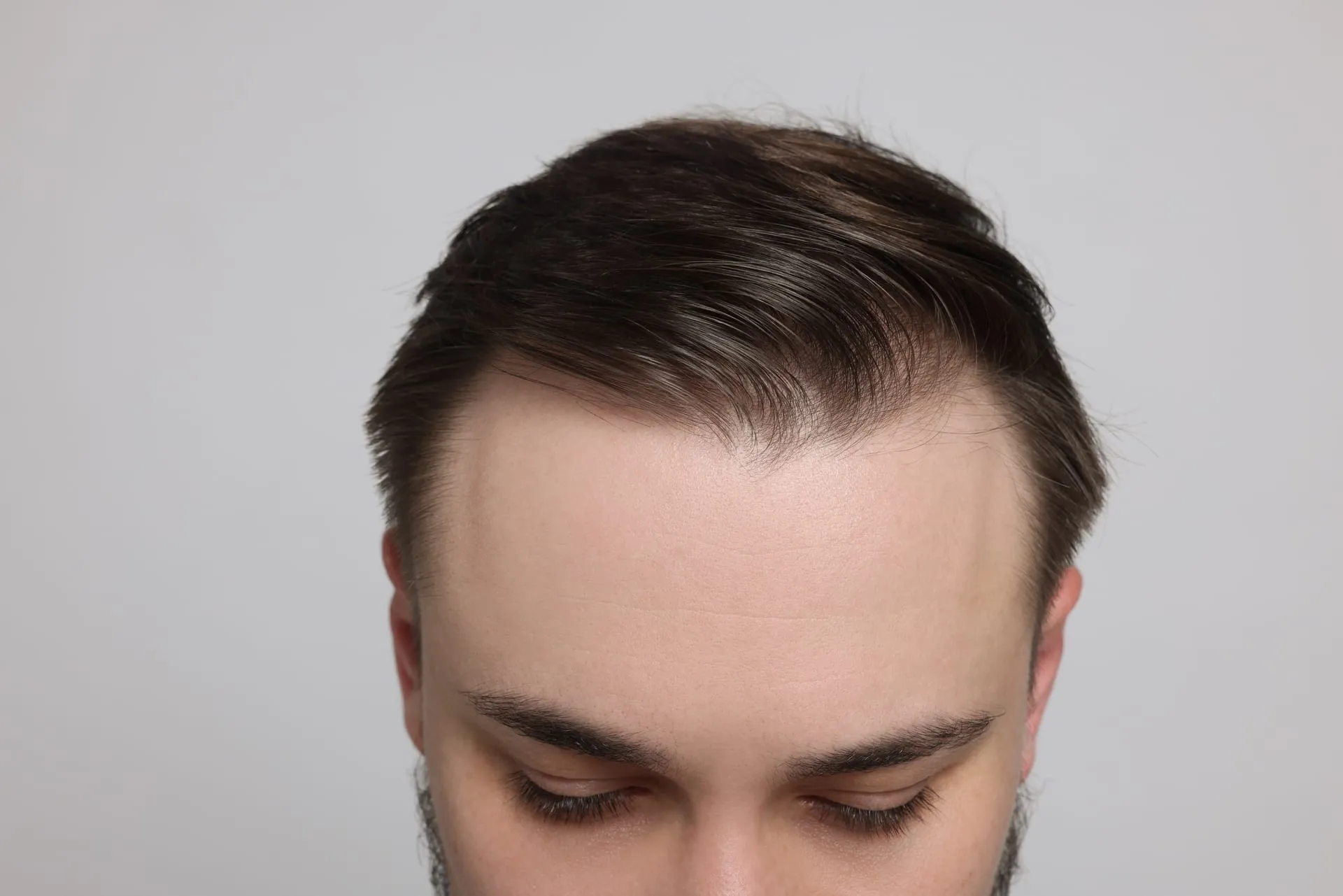
The most common mistake: a hairline that is too low or too hard
A hairline that is set too low eats up grafts – and not even “to great effect”, but expensively: it massively increases the area. It can also look unnatural later if the hair loss behind the line progresses.
A good hairline does not look young because it is low, but natural because it suits your face, your age and your future reserves.
High forehead: when does “a little further forward” become a major operation?
A high forehead is not automatically hair loss. Some people have a genetically high hairline. Even so, the wish for a lower hairline is understandable.
What many people underestimate: as soon as you move the hairline forward by just one or two centimetres, a large area is created. The front is wide, and area multiplies.

Typical guide values for a high forehead
- Hairline slightly forward (small shift, narrow build-up): typically 1,800–2,500 grafts
- Clear shift + wider front zone: typically 2,500–3,000+ grafts
The art here lies not in going “as low as possible” but in getting the proportions right. A lower hairline only looks good if the density behind it is built up to match – otherwise an artificial edge is created.
The strategic argument: protecting reserves
With young patients in particular, the high forehead is an area where it is easy to want “too much”. If genetic hair loss sets in later, the grafts used up at the front are no longer available. That is why sound planning always includes the question: what will this hairline look like in ten years?
Crown: why the whorl has a logic of its own
The crown is tricky. Not only because it is hard to see, but because it works differently from the front.
A whorl almost always shows some scalp – even in people without hair loss. Once hair loss begins, however, the spot quickly looks “bald”, because light falls on it from above and the hairs radiate outwards.

How many grafts does the crown typically need?
- Small, early thinning at the crown: typically 800–1,200 grafts
- Medium crown: typically 1,200–2,000 grafts
- Large crown / widely thinned: 2,000+ grafts (often better planned in stages)
Why stages are so important at the crown: if you fill the crown aggressively, you burn through grafts in a zone that has less visual “impact on the face” than the front. Many patients benefit more from stabilising the front area first and moderately densifying the crown later.
Working with direction instead of “density at any price”
At the crown, the direction of placement must imitate the whorl. Anyone who simply piles on density here gets hair that falls unevenly and, in the worst case, a result that looks artificial even with a high number of grafts.
How aggressively should the first hair transplant be planned?
If you take away only one thought from this article, let it be this: the first operation sets the rules for everything that is possible later.
The Hair Doctors notes warn precisely against wanting “everything” in the first step if the hair loss may still progress. That is not overcautious but professional. Because the donor area is finite – and if you overtax it, you cannot undo it.
Sensible initial planning therefore answers three questions:
- Which zone brings the greatest aesthetic benefit? (usually the front/frame)
- How great is the risk that the hair loss will spread?
- What reserves should be kept for later densification or further areas?

What hair density is realistic after a treatment?
Many people only talk about “graft numbers”, yet density is what really changes how you look. It is almost never realistic to copy your natural original density completely. The goal is a result that looks dense in everyday life – in normal light, from a normal angle, with a normal hairstyle.
Especially with limited reserves, it is often wiser to build up one zone properly and use a densification treatment later if needed, rather than using everything up in the first step.
Questions about how many grafts you need?
Deciding on a hair transplant usually starts with the question of how many grafts are needed – but the answer is as individual as your hair growth itself. At Hair Doctors you receive an honest medical assessment of your donor reserves and strategic planning tailored precisely to your goals for receding temples or the crown – for a result that impresses today and still looks completely natural in the future.
Frequently asked questions (FAQ)
How many grafts is “a lot”?
“A lot” is relative. For a small correction of receding temples, 1,200 grafts can already achieve a great deal. For a large-scale hairline correction or a large crown, on the other hand, 2,500 grafts can quickly be “normal”. What matters is not the number but whether it suits the area and long-term management of the donor area.
Can you transplant an unlimited amount of new hair?
No. A transplant does not create new hair. It is a redistribution from a limited reservoir. The guide values given here show that, in the long term, often only some of the existing follicular units can be safely extracted.
Why do reputable clinics often recommend planning in stages?
Because hair loss can progress and the donor area needs to be protected. Planning in stages prevents you from building a solution today that causes problems tomorrow in terms of appearance or the state of the donor area.
Which is more important: the number of grafts or the technique?
Both. The best number is no use if angle, direction and distribution are not right. Especially at the hairline and crown, the technical execution decides whether the transplanted hair will look natural later.
Conclusion: the right number of grafts is not a number – it is a plan
“How many grafts do I need?” is the right place to start, but not the goal. The goal is a result that looks good today and does not take away your options tomorrow.
A sound consultation measures the area, defines a realistic target density, assesses your hair parameters and plans the use of your donor area strategically. Only then does a range become a number – and a number become a result that still holds up years from now.
Medical note:This article is for general information only and does not replace a medical examination, diagnosis or consultation. Whether a treatment is suitable for you, and which one, should be discussed in person with a specialist. Treatment results vary from person to person.
Safety & quality at Hair Doctors
See our commitment for yourself



Reviews
Patient reviews of our premium partner clinics in Dortmund, Düsseldorf, Hamburg, Nuremberg, Wertheim and Eindhoven (NL):
 Hair DoctorsVerified5,913 reviews on provenexpert.comProud member of the CGCE Group. Read here what real patients of Hair Doctors and the CGCE Group say about us.
Personal 1:1 consultation, no obligation
In person or conveniently by video.
In two consultations we work out with you which treatment suits you.