

Blog · 30 September 2026 · 9 min read
Hair transplants for women: when they make sense and when they don’t
Your parting looks wider, your temples are thinning, or your hairline has always been high – and at some point the question arises whether a hair transplant could help. The honest answer: for some women yes, for many only after the cause has been thoroughly investigated, and for some forms of hair loss rather not.
Medically reviewed by Dr. med. Martin Reifenrath, Specialist in Plastic and Aesthetic Surgery · Last updated:
Key points at a glance
- A hair transplant redistributes existing hair from the back and sides of the head to thinning areas; no new hair is created in the process.
- Good conditions are a clearly defined, stable zone – such as receding temples, a high forehead or a scar – and a dense donor area at the back of the head.
- With diffuse hair loss that also thins the back of the head, a transplant often does not make sense because there is no reserve.
- Beforehand, a dermatologist clarifies the cause, such as iron deficiency, the thyroid or hormonal influences.
- A transplant does not stop hereditary hair loss. It is therefore often combined with drug treatment.
- As a rule, you bear the costs yourself; they depend on the area and the effort involved.
Which women is a hair transplant suitable for?
A hair transplant makes use of a special feature of the fringe of hair: the hairs at the back and sides of the head usually barely react to the hormonal influences that trigger hereditary hair loss. They are moved to thinning areas as small groups of hairs with their roots, so-called grafts.
The procedure is most suitable when the hair loss is limited to a clearly defined zone and is no longer changing rapidly. Typical examples in women are:
- receding temples and thinning hair at the temples,
- a naturally high forehead, where the hairline is to be moved forward a little,
- a hairline that has receded after years of pulling from tight hairstyles (traction alopecia), once the cause has been eliminated,
- scars from accidents or operations where hair no longer grows,
- thin or missing eyebrows (eyebrow transplant).
The international professional society for hair surgery (ISHRS) describes a favourable starting point as a predictable pattern rather than extensive, rapidly progressing loss – and healthy donor hair. In women, the aim is usually to make a zone denser, less often to create a completely new hairline. With scars, the blood supply to the tissue is difficult to predict; sometimes a small test treatment is therefore carried out first and graft growth assessed after about six months.
Why is diffuse hair loss often not a good starting point?
Many women do not notice their hair loss as a bald patch, but as a parting that is getting wider. In hereditary hair loss in women, the area around the centre parting typically thins; men, by contrast, tend to get receding temples and a thinning area at the crown.
For a transplant, this is a problem, because in women the donor area often thins as well. The professional society therefore stresses that donor hair must be checked particularly carefully – it should be resistant to hormone-related hair loss. Where the reserve itself is dwindling, harvesting would only shift the gap.

If, on the other hand, the donor area is dense and stable, a thinning parting can also be made denser. A review in the German medical journal Deutsches Ärzteblatt mentions this option, but rates the evidence for it as low and assesses the achievable improvement in women more cautiously than in men. Possible causes are described in the guides Thin hair in women and Diffuse hair loss in women.
Why must the cause be clarified before a transplant?
Hair loss is a symptom, not a diagnosis. In women, it is often due to influences that can be treated or that subside on their own – a transplant would then be starting in the wrong place.
For unexplained, diffuse hair loss, the review in the Deutsches Ärzteblatt lists laboratory tests including the ferritin level, which indicates the body’s iron stores, and thyroid levels. Medication, starting or stopping hormonal contraception and a recent birth also matter: two to four months after giving birth, increased hair loss often occurs temporarily. If there are signs of a hormonal imbalance, such as acne or increased hair growth on the face and body, the authors recommend a gynaecological-endocrinological examination.

Another reason for a medical assessment: a band-like receding hairline, especially in women after the menopause, can be a sign of an inflammatory, scarring condition – frontal fibrosing alopecia. As long as it is active, a transplant is out of the question. The consensus is that a scarring condition should have been quiet for about two years before a procedure, and in one analysis transplants performed worst in precisely this form.
The right place to have the cause investigated is a dermatologist; more on this in the article Hair loss: which doctor? The guide Hair loss in women gives an overview of the forms of female hair loss.
What role does the donor area play?
Every transplanted hair is then missing from the back of the head, because harvested donor hair does not grow back there. If too much is harvested, the donor area thins visibly – the professional society counts this among the typical mistakes in transplants for women.
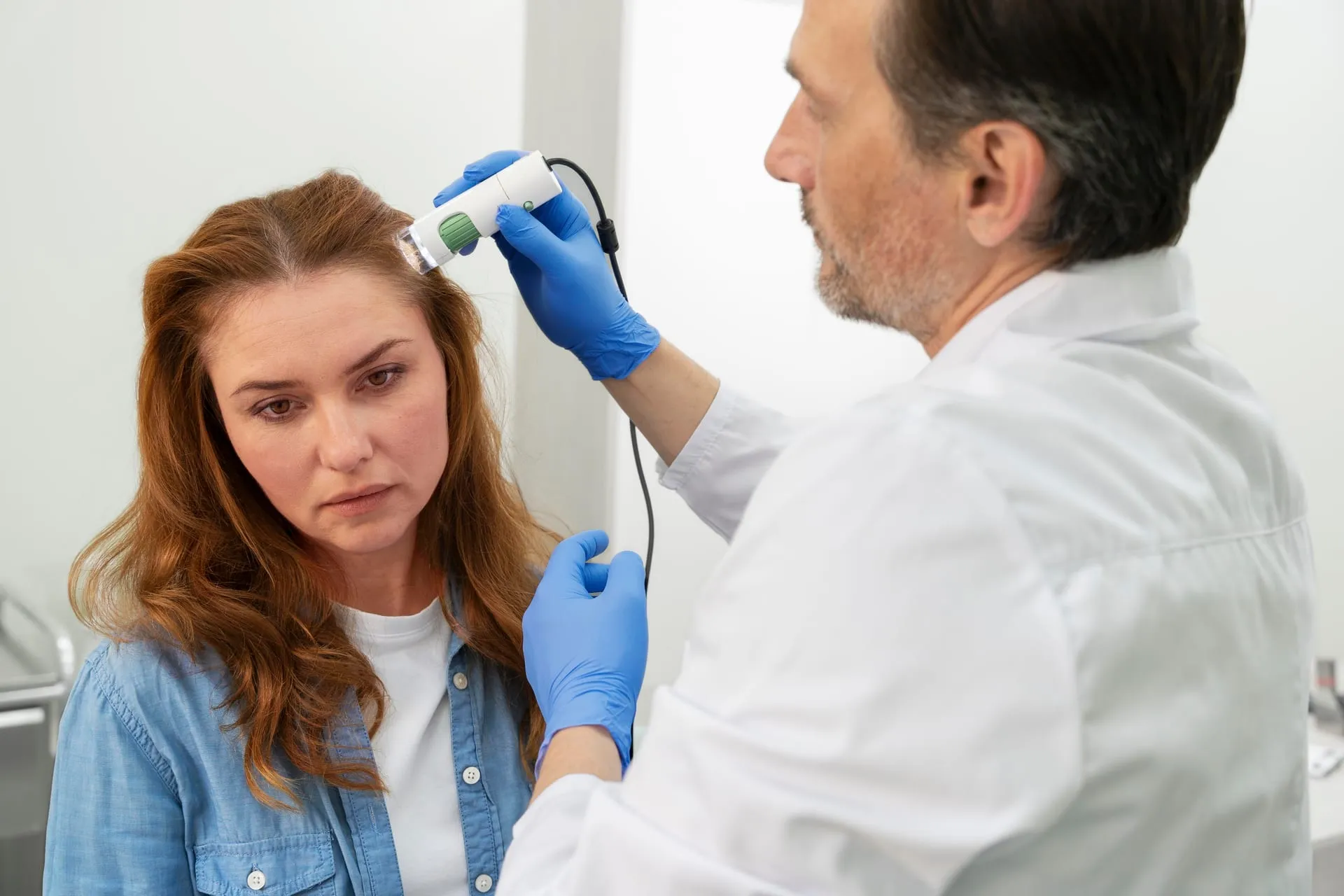
Before planning, it is therefore checked how dense the fringe of hair is, how strong the individual hairs are and whether finer, weakened hairs are already appearing there too – for example with a magnified examination of the scalp (trichoscopy). How the possible number of grafts is derived from area and density is shown in the article How many grafts do I need?
What methods are there – and can it be done without shaving?
Both common procedures work with grafts; they differ in how the grafts are harvested. In the strip technique (FUT), a narrow strip of skin is removed from the back of the head, the wound is stitched and the strip is divided into individual grafts under the microscope. In single extraction (FUE), the grafts are removed individually from the fringe of hair with a fine hollow needle.
For many women, shaving is the deciding question. With the strip technique, the donor area does not need to be shaved, as the surrounding hair covers the harvesting site – one reason why it is often preferred for women. Single extraction is usually performed with a shaved donor area; variants without shaving or with long hair are possible in selected cases, but are more complex. In detail: Hair transplant without shaving and the FUE and FUT comparison.
The design also calls for particular care in women: the hairline is usually softer and rounder, and the parting has to be created so that it falls naturally. Grafts with single hairs belong in the front row for this purpose.
An honest assessment: what a hair transplant cannot do for women
A transplant redistributes hair; it does not increase it. As a rule, the original density therefore cannot be fully restored, and how dense the result looks varies from person to person.
Nor does it stop hereditary hair loss: the non-transplanted hairs in the surrounding area may continue to thin. A recent review therefore counts accompanying drug treatment prescribed by a dermatologist as part of the treatment concept for women.
After the procedure, swelling that can last a few days, crusts, a feeling of tightness and numbness on the head are possible. Infections are rare. Scars remain in the donor area: a fine line with the strip technique, many small, dot-like scars with single extraction. Neither method is scar-free.
One risk that affects women more than men is so-called shock loss, in which existing hairs in the treated area fall out, typically two to six weeks after the procedure. This is usually temporary, but sometimes permanent.
Finally, it takes patience: the transplanted hairs usually fall out after a few weeks, new growth only appears after months, and it often takes a year or more before the result can be assessed (more on this in the article Hair transplant: the timeline). Not every woman is a suitable candidate – a reputable consultation also includes a well-founded no.
How much does a hair transplant for women cost?
The price depends on the area, the number of grafts and the effort involved in the method, not on gender. A hair transplant is, as a rule, paid for privately; health insurers generally do not cover the costs.
As a guide, here are the three Hair Doctors price tiers according to the Costs & prices page:
- small hair transplant, for example eyebrows or eyelashes: €2,400 to €3,600
- medium hair transplant, for example the hairline, receding temples or the temples: €3,600 to €4,800
- large hair transplant, for example the front or back of the head: €5,500 to €8,500
Included are, among other things, laboratory tests, anaesthesia, the outpatient stay, and aftercare and check-ups. Which tier applies to you is determined in the consultation; the graft calculator gives an initial guide value for receding temples and a high forehead, and all details can be found under Costs & prices.
Have your situation assessed in person
Whether a hair transplant makes sense for you can only be answered after an examination. In a 1:1 consultation with no obligation, we discuss your situation, any existing findings from your dermatologist and your goals – and tell you openly if we advise against a procedure. Before a hair transplant, we plan two consultations; in them we also clarify which method is an option for you and at which location it is offered.
The consultation is possible in person at six locations – in Dortmund, Düsseldorf, Hamburg, Nuremberg, Wertheim and Eindhoven (NL) – or by video. Our doctors introduce themselves under Specialists.
Frequently asked questions
Is a hair transplant possible for women?
Yes, if the conditions are right: a clearly defined, stable zone such as receding temples, a high forehead or a scar, and a dense donor area at the back of the head. With diffuse hair loss that also thins the back of the head, a transplant often does not make sense. Whether you are a suitable candidate can only be determined after a medical examination.
Does a hair transplant help with thin hair?
That depends on the cause and on the donor area. If the hair is thinning all over the head, there is often no reserve to harvest from. If the back of the head is dense and stable, a thinning parting can be made denser, but this does not fully restore the original density. Possible causes are explained in the guide Thin hair in women.
How much does a hair transplant for women cost?
The price depends on the area and the effort involved, not on gender. Hair Doctors has three price tiers: €2,400 to €3,600 (small), €3,600 to €4,800 (medium, e.g. hairline or temples) and €5,500 to €8,500 (large). As a rule, you bear the costs yourself; details can be found under Costs & prices.
What are the risks of a hair transplant for women?
Swelling, crusts, a feeling of tightness and numbness on the head are possible; infections are rare. Scars remain in the donor area, even with single extraction. Women also have a higher risk of so-called shock loss, a usually temporary loss of existing hair in the treated area.
Can a hair transplant for women be done without shaving?
Often, yes. With the strip technique, the donor area does not need to be shaved; the surrounding hair covers the harvesting site. Single extraction is usually done with shaving; variants without shaving are possible in selected cases. More on this in the article Hair transplant without shaving.
How meaningful are other women’s experiences?
Personal accounts give an impression of the procedure, healing and everyday life after the operation. But they can hardly be applied to your own situation, because the cause, donor area and hair quality are different for every woman. Check whether the starting point was comparable, whether at least a year has passed since the procedure and whether side effects are also described openly.
When can you see the result of a hair transplant?
Not straight away. The transplanted hairs usually fall out after a few weeks, while the roots remain in the skin. New growth appears after a few months; it often takes a year or more before the result can be assessed. The article Hair transplant: the timeline describes how things progress over time.
Medical note:This article is for general information only and does not replace a medical examination, diagnosis or consultation. Whether a treatment is suitable for you, and which one, should be discussed in person with a specialist. Treatment results vary from person to person.
Show sources (6)
- Wolff H, Fischer TW, Blume-Peytavi U (2016): Diagnostik und Therapie von Haar- und Kopfhauterkrankungen. Deutsches Ärzteblatt 113(21): 377–386. DOI 10.3238/arztebl.2016.0377. api.aerzteblatt.de/pdf/113/21/m377.pdf
- International Society of Hair Restoration Surgery (ISHRS) (o. J.): A Guide to Hair Transplant for Women. Abgerufen am 30.09.2026. ishrs.org/hair-transplant-for-women
- International Society of Hair Restoration Surgery (ISHRS) (o. J.): Guide to FUE Hair Transplant: Benefits, Process & Recovery. Abgerufen am 30.09.2026. ishrs.org/fue-what-is-it
- Queen D, Avram MR (2025): Hair Transplantation in Women. Journal of Drugs in Dermatology 24(9): 851–855. PMID 40911748. doi.org/10.36849/jdd.8988
- Kerure AS, Patwardhan N (2018): Complications in Hair Transplantation. Journal of Cutaneous and Aesthetic Surgery 11(4): 182–189. pmc.ncbi.nlm.nih.gov/articles/PMC6371733
- Singh S, Muthuvel K (2021): Role of Hair Transplantation in Scarring Alopecia – To Do or Not to Do. Indian Journal of Plastic Surgery 54(4): 501–506. pmc.ncbi.nlm.nih.gov/articles/PMC8719951
Personal 1:1 consultation, no obligation
In person or conveniently by video.
In two consultations we work out with you which treatment suits you.